


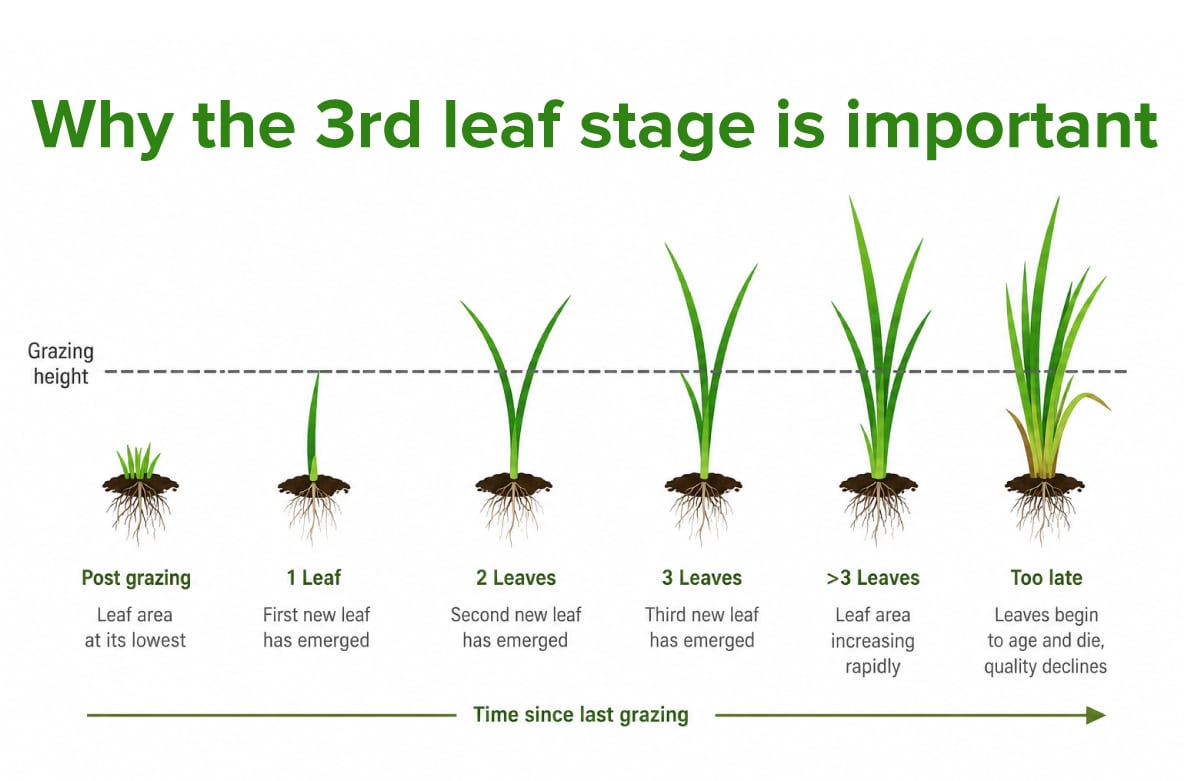
Leaf stage is one indicator to match current rotation with pasture growth. We explain why.
Looking at how many new leaves have emerged since the last grazing, you can quickly see how well a paddock has recovered and whether your current rotation matches pasture growth.
Rather than relying on calendar days, it measures how much new leaf has grown since the previous grazing, helping match grazing decisions with actual pasture growth.
Leaf stage is a guide, not a rule. While the 2.5–3 leaf stage is the ideal biological target for ryegrass, grazing decisions should also consider pasture cover, feed demand, weather, soil moisture and stocking rate. The best results come from balancing all of the aspects.
Why 3 leaves?
A ryegrass tiller generally carries three healthy, living leaves. As the fourth leaf emerges, the oldest leaf begins to die. This means delaying grazing beyond the three-leaf stage reduces feed quality and increases the amount of dead material in the pasture.
| Leaf stage | What you’ll see |
|---|---|
| Post grazing | Small amount of green leaf remaining |
| 1 leaf | First new leaf has emerged |
| 2 leaves | Canopy filling quickly |
| 3 leaves | Full green canopy |
| 4th leaf | Oldest leaf beginning to die |
Aim for a fully recovered pasture
As ryegrass pasture regrows, each new leaf increases the plant’s ability to capture sunlight and produce energy. By the time the third leaf has emerged, the plant has restored a large proportion of its energy reserves and developed a full canopy of productive green leaves.
Avoid grazing too soon
Repeated grazing before two new leaves have developed reduces the amount of green leaf available for photosynthesis. Over time this can slow recovery, reduce tiller development and limit seasonal pasture production.
Understand leaf turnover
A ryegrass tiller generally maintains around three live green leaves. As the fourth leaf begins to emerge, the oldest leaf naturally starts to die and decompose. This continual cycle of new leaf growth and older leaf replacement is a normal part of pasture development.
Using leaf stage on your farm
Monitoring leaf development throughout the year can help:
- Match grazing intervals to pasture growth.
- Encourage greater tillering and pasture density.
- Maintain a larger proportion of productive green leaf.
- Support pasture persistence and seasonal feed production.
- Make grazing decisions based on plant development rather than calendar days.
Leaf stage is one of the simplest tools available for understanding pasture growth and getting the most from perennial ryegrass throughout the year.
