


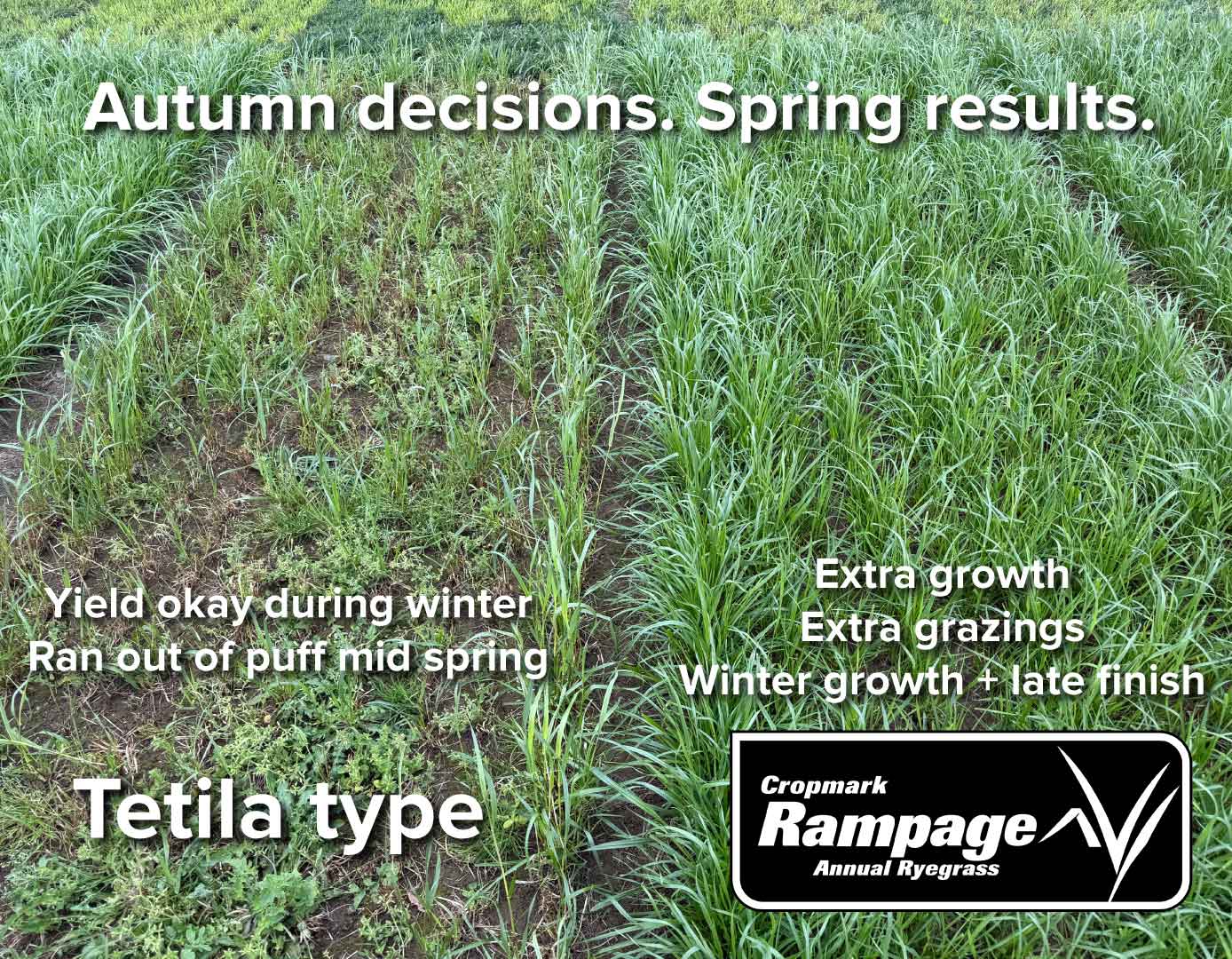
Not all annual ryegrasses perform the same way throughout the growing season.
Some varieties establish quickly and produce reasonable winter feed but lose momentum as spring progresses. Others are bred to combine strong winter production with sustained leafy growth into late spring and early summer.
That’s where our Rampage Annual Ryegrass stands out.
Developed through Cropmark Seeds’ forage breeding and selection programme, Rampage is a high-performing tetraploid annual ryegrass selected for rapid establishment, exceptional winter growth, strong recovery after grazing and the ability to maintain quality feed later into the growing season.
For farmers, the advantage isn’t simply how much feed a variety can grow from an Annual Ryegrass. It’s when that feed is available and how long it remains useful – especially in parts of the country where spring rainfall can extend the growing season.
Cropmark genetics: Breeding for a longer growing season
Late-heading genetics are an important part of modern annual ryegrass breeding.
Traditional early-heading annual ryegrasses like Tetila can transition into reproductive growth relatively early in spring. As seed heads develop, pasture quality and grazing utilisation can decline, particularly as stems become more prominent.
Cropmark’s breeding approach with Rampage has focused on combining strong winter activity with a later transition to reproductive growth.
With a late heading date, approximately 20 days later than the Nui reference, Rampage has the potential to maintain leafy, high-quality forage for longer.
Combined with low aftermath heading and rapid regrowth after grazing, these characteristics help sustain pasture quality and productivity across a wider seasonal window, especially spring.
The objective is straightforward: strong production when winter feed is needed, without sacrificing valuable spring growth.
More flexibility. More options. Better planning.
One of Rampage’s greatest advantages is the additional flexibility it can bring to farming operations.
Spring is a demanding period. Farmers are balancing grazing rotations, silage and hay production, paddock renovations, summer cropping programmes and changing weather conditions.
Having an annual ryegrass that continues producing useful leafy feed later in the season can make those decisions easier.
Rampage opens up several practical opportunities:
- Extra grazing opportunities: Continued spring growth can provide additional grazing rounds before paddocks are removed from production.
- Greater renovation flexibility: Maintain feed availability while planning pasture renewal or preparing paddocks for summer crops.
- More fodder conservation options: Extended leafy growth can provide greater flexibility around silage and hay decisions.
- Better use of spring moisture: Take advantage of favourable growing conditions rather than losing productive potential through early maturity.
- Less pressure on feed planning: A longer grazing window can help bridge seasonal feed gaps and reduce pressure on other paddocks.
For dairy farmers, this can mean more opportunities to maintain quality pasture in the diet through spring. For beef and sheep enterprises, it can support grazing rotations, livestock finishing and decisions around conserving surplus feed.
Importantly, later heading does not guarantee additional feed under every seasonal condition. Soil moisture, fertility, grazing management and temperature will still determine how long productive growth continues.
Winter growth matters. The spring finish matters too.
When selecting an annual ryegrass, winter production often receives the most attention. Understandably, farmers want early establishment and reliable feed through the cooler months.
However, a variety that combines strong winter activity with sustained spring growth can deliver additional value across the whole season.
Rampage has been evaluated in Australian and New Zealand trials, including multi-year dryland trials at Ellinbank, Victoria.
Its combination of winter growth, late heading and strong late-season production has helped establish Rampage as an attractive option for farmers seeking high-performing, homegrown feed.
The difference becomes particularly evident in spring, when early-maturing annual ryegrasses may begin losing quality and productivity while later-heading material continues producing leafy growth.
It’s a reminder that pasture variety selection should consider the entire growing season, not simply the first few grazings.
Making every hectare work harder
At Notman Pasture Seeds, we believe successful pasture programmes start with understanding how varieties fit into the whole farming system.
Rampage is well suited to farmers seeking productive winter grazing, high-quality spring feed and greater flexibility around fodder conservation or summer cropping.
With exclusive access to Rampage in Australia, Notman Pasture Seeds works with farmers to match its genetics to their livestock requirements, seasonal conditions and pasture renovation programmes.
The right decision in autumn can create more opportunities in spring.
Talk to the Notman team about incorporating Rampage Annual Ryegrass into your next pasture programme.
