

After a tough summer in 2024–25, many farms are now facing the challenge of rebuilding their perennial pasture base heading into autumn 2026.
With many farmers recording less than significant rainfall for more than six months during the summer of 2024 – 2025.
Our production base of perennial ryegrass was decimated, farmers in the South-West were forced to sow Annuals, Italians and cereals to fill a winter short fall with many farmers not having feed until late August.
The autumn of 2026 leaves farmers the task of returning to a perennial base.
The 30/30 program of the mid to late 2000’s demonstrated that farm that can grow and maintain a 60 – 65% perennial base perennial base, proved to be the most sustainable, manageable and profitable of the pasture-based systems in the Western Districts.
The Western District is now faced with the issue of not being able to return the majority of the farm back to a perennial in the one year, due to the fact of the time delay to the first grazing during the year of establishment.
Paddocks that were sown to summer crop last spring can be returned to perennial ryegrass this autumn; however, this may only equate to 15 – 25% of the grazing area.
Pasture Density Evaluation
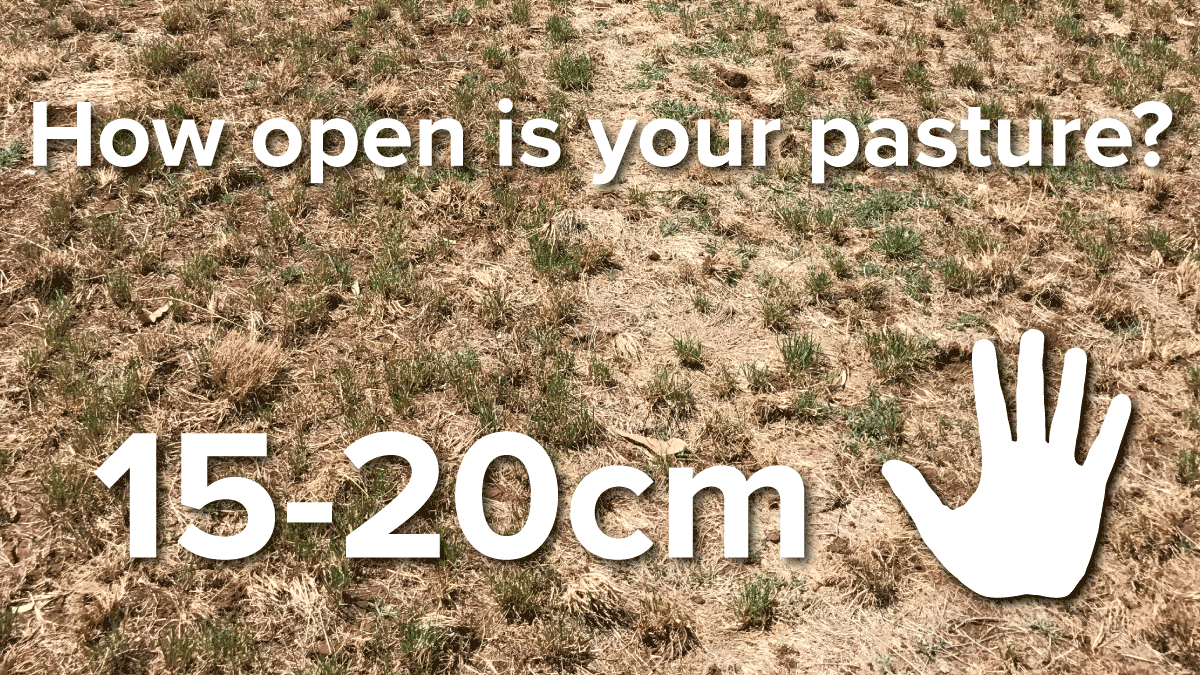
If you cannot touch from one plant to another with an open hand (15 – 20cm), then the sward is too open. This helps determines whether the tiller density will fill in the gaps over a 3-month period post the autumn break.
If the gap is more than 15 cm, over sowing is recommended, as this could equate to a loss in winter production
If the sward is too sparse, the next step is to evaluate what weeds are present.
Question: Can they be selectively controlled or is a full renovation program needed?
What are you working with?
Which Species Where?
If the weed control is selective (i.e. winter grass, barley grass or brome grass), then spray (i.e. Paraquat, Paraquat/Diquat or Ethofumesate) and sow back to a similar maturity perennial ryegrass.
If using Paraquat/Diquat, wait until the Barley, Brome and winter grasses have reached the two-leaf stage after the break. This is usually three weeks after germination.
Identify worst paddocks first, where barley grass or winter grass is substantial, an annual may be considered and a cropping paddock can be integrated to increase the number of sprayings to break the seed bank.
If Ethofumesate is used and sowing dry, apply at half rate as a pre-emergent and then wait until newly sown ryegrass is at 2 – 3 leaves before spraying winter grass or barley grass with a second application.
Weeds that are more difficult
Including bent grass, kikuyu and couch, then a full renovation program is required
Program as follows:
- Complete Spray knock down: Use Glyphosate 540 + Dicamba 500 + Rage 400 Carfentrazone and suitable insecticide
- Where paddocks are not too rough, a direct drill can be considered.
- Where damage is significant, smudging or harrowing or lightly discing could be considered to level off paddock before direct drilling or a power harrow with a seed box maybe a better option to achieve seed soil contact, with the aim of the sowing depth of up to 1.5 cm.
Options available
OPTION A: Sowing times – dry starts
Annuals
Annual such as Rampage or Ed MAX from February 28th through to April 10th, oversowing at 25-30kg/ha.
- If you have a difficult weed problem – Go Annual
- An Annual gives you a Summer Crop Paddock
- Annual ryegrass, becomes an option again post 10th May + Cereal as a cover crop (depending upon soil type) to bolster feed on offer for the first grazing.
Italians
Oversow Italian ryegrass such as Vibe, Feast II or Arise at 20-25kg/ha from March 1st to May 20th.
- Italians generally out yield annual ryegrasses from the first week in September
- Italians on average, grow about one tonne more per year compared to an Annual
- Holds quality, maintains density
- Moisture availability guarantees late season production
Perennials and hybrids
Oversow perennial grasses from March 23rd to May 10th at 15-20kg/ha
- When oversowing, pasture cover must be grazed down very hard (i.e. less than 800 kg/ha)
- This must be sown early or just after the autumn break
- In heavier soils, slug bait such as Metarex must be applied in all over sowing situations
- Cricket bait also an important consideration
Cereals
Cereals such as ryecorn, barley, oats and triticale at 80-100kg/ha from April 15th onwards.
In a mixed WinterCrop options include sown as a cover crop at 40-50kg/ha with Annual or Italian Ryegrass at 20-25kg/ha.
Generally, Oats + Vetch or Oats and Peas are sown later in the season and considered silage or hay options as there is limited regrowth from the Vetch or Pea.
Brassica crops
Brassicas could be sown between March 17th and April 15th, including Appin Leafy Turnip or a forage brassicas like Rifleman, Mainstar or Pillar.
Forage Rape offers better regrowth potential than a leafy turnip, though a leafy turnip will have more feed on offer for the first grazing.
WinterCrop mixes could look like:
- Annual Ryegrass at 20 -25kg/ha + Appin Turnip 1 – 2 kg/ha
- Annual Ryegrass at 20- 25 kg/ha + Forage Rape 1 -2 kg/ha
OPTION B: New sowing or where Pasture Density is very open
Annuals (Tetraploids such as Rampage): 30 – 40 kg/ha
Italians (Assuming Diploids such as Vibe) 25 – 30 kg/ha
Perennial and Hybrids (Assuming diploids such as Stampede CM142 or Matrix SE) 25 – 30 kg/ha
Tetraploid perennials – If sowing tetraploids such as Elevate CM142, 4Front NEA2 or Base AR37) increase the sowing rate by 30 – 40%
If broadcasting, increase sowing rate by 30 – 50% to ensure satisfactory germination, only consider this option on cultivated ground.
Important considerations
- Sow to Annual ryegrass “If summer crops are to be sown in October/November” or Italian ryegrass that can maximise the season until moisture becomes limiting. • Italian ryegrass paddocks that are going to be sown this autumn and not cropped, can become annual paddocks next autumn.
- For every 10 kg sown above a base sowing rate of 15 kg per ha for a diploid in an over sowing situation, amount of feed grown over the standard sowing rate was 500 kg per ha.
- For every 21 days after early March, pasture yield can be depressed up to 600 kg.
- Annual and Italian ryegrasses can produce up to twice the amount of feed over a newly sown perennial to the third grazing.
- An Italian and annual ryegrasses are a cropping tools and are a means of returning to a perennial end
Ranking paddocks
Rank paddocks according to plant density and percentage of perennials. Ranking is based on:
- No action required
- Density is fine
- Observe and act if paddock does not respond
- Need to act due to plant density, weeds, pugging, and pests or are annual based from the previous season.
Every farm will be starting autumn from a different position this year, and pasture decisions made now will influence feed supply for the next two to three seasons. Ranking paddocks, understanding pasture density, and matching the right species to each paddock is critical to rebuilding a productive and resilient perennial base.
For tailored advice around pasture assessment, renovation options and autumn sowing plans, get in touch with Andrew Allsop to discuss your farm’s situation and plan the next steps with confidence.
Andrew Allsop